
Skilled physical therapy and rehabilitation care for patients throughout Wheaton, MD.
If you’re recovering from an injury or surgery or living with chronic pain that keeps you from the activities you love, the right rehabilitation program can help you rebuild strength in a safe way. Our Wheaton, MD physical therapy is here to help people restore strength, movement, and confidence through hands-on, individualized care.
Mid-Atlantic Spinal Rehab & Chiropractic has supported Maryland patients since 2012, keeping physical therapy and chiropractic within one practice instead of scattering your care. It was founded by Dr. Marc Gulitz, who built the clinic around the rehabilitation of musculoskeletal injuries. When you’re ready to begin, we welcome you to schedule a consultation.
Physical Therapy in Wheaton, MD
Physical therapy restores the strength, mobility, and coordination that injury, surgery, or chronic strain can take away. Rather than masking discomfort, it rebuilds the body’s ability to move well on its own. Our providers combine hands-on techniques, guided exercise, and clear education, so you understand both what we are doing and why it helps.
Patients come to us from across Wheaton and the surrounding Montgomery County area. Some are recovering from an operation or a car accident. Others are managing a long-standing condition or working back toward a sport or a job that asks a great deal of their body. We treat people of every activity level, and every program begins with your specific goals.
Physical Therapy Services We Offer in Wheaton
Because every injury and every body recovers differently, we never rely on a single template. We start by understanding your goals and what is limiting you, then design a program around both. These are the services Wheaton patients turn to most.
- Post-surgical rehabilitation. After an operation, the right program protects the repair while steadily rebuilding motion and strength. We follow your surgeon’s guidelines and progress you at a pace your body can handle, with a confident return to normal activity as the goal.
- Auto accident and injury rehabilitation. A collision can leave pain and weakness that linger long after the visible injuries heal. We rehabilitate the whiplash and soft tissue damage a crash leaves behind, and we address the personal injury side so your recovery and your claim stay aligned.
- Sports injury rehabilitation. Whether the trouble is a sprain, a strain, or an overuse injury, we work to return you to your sport without inviting a repeat. Treatment blends recovery with the strength and mechanics that guard against reinjury.
- Chronic pain rehabilitation. Persistent back, neck, or joint pain often responds to a steady, structured program when quick fixes have not. We focus on restoring function and easing the day-to-day limits that ongoing pain imposes.
- Balance and vestibular therapy. Dizziness and unsteadiness can make even simple movement feel risky. Focused exercises retrain the systems that keep you balanced, which lowers the chance of a fall.
- Work injury rehabilitation. An injury on the job can sideline both your health and your livelihood. We treat the injury, document your progress clearly, and prepare you for a safe return to the demands of your work.
- Corrective exercise programs. The progress you make in the clinic needs support at home. We design specific, manageable exercises that reinforce your gains and address the weaknesses behind the original problem.
- Postural and movement screenings. Many injuries trace back to how the body moves and holds itself day to day. Our screenings reveal the patterns that lead to strain, so we can correct them before they cause lasting trouble.
Why Choose Mid-Atlantic Spinal Rehab & Chiropractic for Physical Therapy in Wheaton, MD?
Rehabilitation and Chiropractic, Together
Recovery often improves when more than one discipline is involved, so we keep physical therapy and chiropractic care under one roof. Your providers compare notes and adjust the plan as a unit, rather than treating you in pieces. When a case calls for it, we also coordinate with physicians, neurologists, and orthopedists so your Wheaton care stays connected from start to finish.
Founded on Injury Recovery
Our practice was founded by Dr. Marc Gulitz, who built it around the rehabilitation of musculoskeletal injuries. He earned his Doctor of Chiropractic degree from Northeast College of Health Sciences and serves on the board of the Maryland Chiropractic Association, working within an integrated model alongside physical therapists and physicians. Since 2012, our practice has grown into one of Maryland’s fastest-growing rehabilitation providers, with locations across the region that have supported thousands of residents in recovery.
Understanding Physical Therapy
Conditions We Treat and Treatment Options
Much of what we treat involves the muscles, joints, and connective tissue that move and stabilize the body. Some problems arrive suddenly, through surgery, a fall, or a collision. Others build over time from overuse, poor mechanics, or a condition that gradually limits movement.
The situations we treat most often include:
- Post-surgical weakness and stiffness. After an operation, tissue needs careful, progressive loading to regain its strength. We rebuild that capacity while respecting the limits of your recovery.
- Whiplash and auto accident injuries. A crash sends force through the body that it never anticipates, and the effects can linger for weeks. We restore the movement and strength these injuries take away.
- Sciatica and nerve-related pain. An irritated nerve can send pain, numbness, or tingling into the hip, the leg, or the foot. We work to relieve that pressure and rebuild comfortable movement.
- Chronic back and neck pain. Long-standing pain often improves with a structured program that addresses both strength and mechanics rather than symptoms alone.
- Dizziness and balance issues. Problems with balance can make daily life feel precarious. Targeted therapy retrains the systems that keep you steady on your feet.
- Sports and overuse injuries. Repetitive strain and athletic injuries respond well to graded rehabilitation that prepares the body to return to demand.
Most programs combine hands-on therapy, guided exercise, and education, arranged to fit your recovery. What we recommend depends on your evaluation, your history, and how your body responds. And if your needs reach beyond physical therapy, we will tell you directly and help you find the right care.
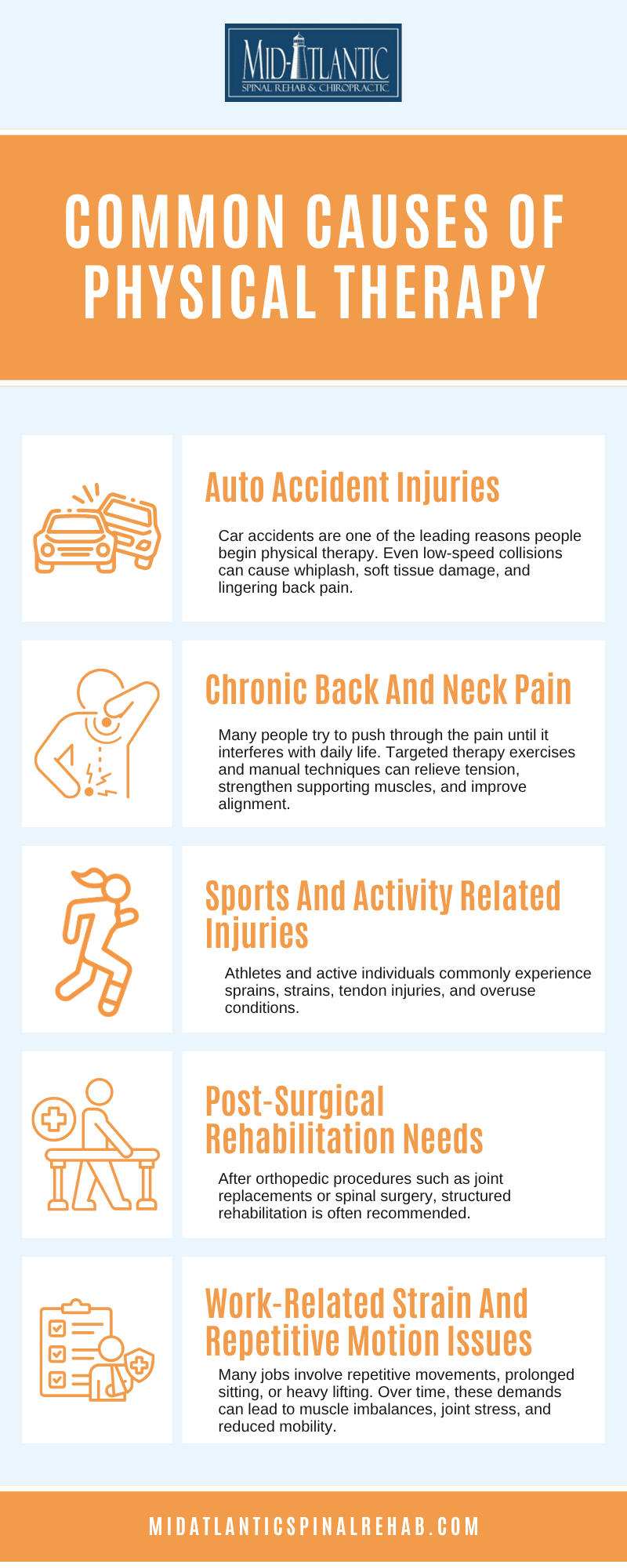
Wheaton Physical Therapy Infographic
What Should You Expect from Physical Therapy?
Starting therapy somewhere new is easier when you know what lies ahead, so here is how care with us generally unfolds.
- It begins with a thorough evaluation of your movement, strength, and range of motion, along with a real conversation about your goals.
- We then explain what we found in plain language and outline a plan together, so the direction feels like yours rather than a decision made for you.
- Each session blends hands-on treatment with guided exercise, kept within a range that challenges you without overwhelming you.
- You leave with a home program, because the work you do between visits is often where the steadiest progress happens.
What Is the Typical Treatment Timeline?
Every recovery moves at its own pace, so read these stages as a general guide rather than a fixed schedule.
- The first visit centers on evaluation, a working understanding of your condition, and a plan shaped around your goals.
- Early sessions focus on easing pain, calming inflammation, and restoring gentle, controlled movement.
- As you progress, the work shifts toward building strength, endurance, and the stability that protects against another setback.
- Later sessions prepare you to return to the activities, sport, or job that matter to you.
- Many patients finish with a maintenance program they can carry forward on their own.
How long the process takes depends on the injury or condition, your overall health, and how consistently you follow the plan we build together.
What Should You Bring to Your First Visit?
A little preparation helps us make the most of your first visit and saves time at the start.
- A referral or prescription, if your insurance or physician requires one.
- Your insurance card and a photo ID.
- Comfortable clothing you can move and exercise in freely.
- A current list of your medications, along with any relevant imaging or records.
From there, expect a careful evaluation and an honest conversation about what you hope to regain. You will leave knowing the next steps and the reasoning behind each one.
What Are Some Important Maryland Physical Therapy Resources?
Before entrusting your recovery to anyone, it helps to verify their credentials and read from sources with nothing to sell. Maryland and national organizations make that straightforward, and the resources below are a reliable starting point for Wheaton patients.
- The state’s physical therapy board licenses and oversees the therapists who practice in Maryland, and you can confirm a provider’s standing through it.
- The American Physical Therapy Association of Maryland outlines the physical therapy regulations that govern practice across the state.
- On the clinical side, the National Library of Medicine offers plain-language rehabilitation information on what therapy involves and what to expect.
These resources are meant to inform rather than replace a hands-on evaluation. For guidance specific to your situation, consult a licensed provider.
Contact Mid-Atlantic Spinal Rehab & Chiropractic
Recovery tends to go better the sooner it begins. Whether you are healing from surgery, working through an injury, or managing pain that has worn on you for months, our physical therapy in Wheaton is built to rebuild your strength and movement from the source. Every new patient starts with a thorough evaluation and a straightforward conversation about what getting better will involve. Contact us to request an appointment, and a member of our office will follow up to find a time that works for you. Wherever you are starting from, we will help you understand your options from the very first visit.
Physical Therapy Statistics in Wheaton, MD
 Physical therapy exists to restore what injury, surgery, and time take away: strength, balance, and the ability to move without pain. Wheaton has a real need for that kind of care. The community mixes active commuters and workers who get hurt and want back to full function with a sizable population of older adults for whom mobility is tied directly to independence.
The figures below show how widespread the conditions physical therapy addresses have become, both nationally and close to home.
- More than one in four adults age 65 and older falls each year, and falls drive roughly 3 million emergency visits among older adults annually, according to CDC fall data.
- An estimated 21.2% of adults, about 53.2 million people, have doctor-diagnosed arthritis, based on CDC arthritis data for 2019 to 2021.
- Only 24.2% of adults met the federal guidelines for both aerobic and muscle-strengthening activity in 2020, while 46.3% met neither, per CDC activity data.
- In Montgomery County, 18.0% of residents are age 65 or older, according to county census data.
Questions to Ask Before You Start Physical Therapy
Physical therapy works best when you understand the plan and take part in it. Asking a few direct questions at the start sets clear expectations and helps you judge whether a provider is the right fit. The list below covers what is worth raising during your first visit.
- What is actually causing my problem? A good evaluation ends with a clear explanation, not just a treatment. Understanding whether your pain comes from a joint, a muscle, or a nerve tells you what the plan is meant to fix and why.
- What are the goals of my treatment? Recovery should have a target, whether that is walking without a limp, returning to a sport, or lifting your child again. Naming the goal early keeps the plan focused and gives you a way to measure success. It also lets you and the therapist agree on what a finished course of care actually looks like.
- How many visits will this take? No one can promise an exact number, but an experienced therapist can give you a realistic range based on your condition. That estimate helps you plan around work, cost, and the rest of your life. If the timeline shifts as you progress, a good provider will explain why rather than leaving you guessing.
- What should I do between sessions? The time outside the clinic often matters more than the time in it. Ask for specific at-home recommendations so your progress continues on the days you do not have an appointment.
- What should I avoid while I heal? Certain movements or activities can set recovery back. Knowing which ones to modify or skip protects the gains you make and keeps a flare-up from erasing weeks of work. This is especially worth asking about if your job or sport involves the exact motion that caused the injury.
- How will we track progress? Ask how the therapist will measure your progress over time. Regular checkpoints tell you whether the plan is working and when it is time to adjust course.
- What is your experience with my condition? Background matters, and it is fair to ask. Knowing what to weigh when choosing a physical therapist helps you feel confident that your provider has handled cases like yours before.
- How can I get the most out of this? A short conversation about how to make the most of your sessions can shape your whole experience. Consistency, honesty about your symptoms, and steady effort on the home program tend to matter more than any single technique. The patients who treat therapy as a partnership usually recover faster than those who wait to be fixed.
Clear answers to these questions turn physical therapy from something done to you into something you actively drive, which is usually where the best results come from.
Wheaton Physical Therapy FAQs
What does a physical therapist do?
A physical therapist evaluates how your body moves and builds a plan to restore strength, mobility, and function after injury, surgery, or illness. Treatment blends hands-on techniques with guided exercise, and it often includes education about posture and movement. The aim is to help you return to daily activity and, where possible, to reduce reliance on medication or surgery to manage the problem.
Do I need a referral to start physical therapy?
In Maryland, you can begin physical therapy without a physician’s referral in many cases, though some insurance plans still require one for coverage. It is worth checking your policy before you start. Our staff can confirm what your plan needs and help you gather any paperwork, so a referral requirement does not delay the care you are ready to begin.
Does physical therapy hurt?
Therapy should challenge you, not injure you. Some exercises produce mild soreness as weakened muscles start working again, similar to the feeling after a workout. Sharp or worsening pain is different and should be reported right away. A good therapist adjusts the intensity to your tolerance, and learning whether therapy hurts puts many first-time patients at ease.
How many physical therapy sessions will I need?
It depends on the injury, how long it has been present, and how your body responds. A minor strain may resolve in a few visits, while recovery from surgery or a serious accident can take longer. Your therapist reassesses along the way and adjusts the plan. The goal is to reach your target and taper off, not to keep you coming back indefinitely.
What should I wear to physical therapy?
Comfortable, loose clothing you can move freely in works best, along with supportive shoes. If we are treating a knee or ankle, shorts help; for a shoulder, a tank top or loose shirt makes the joint easier to reach. You do not need special gear. The main goal is clothing that lets you move and lets the therapist see how the area is functioning.
Will insurance cover my physical therapy?
Many health plans include physical therapy benefits, and auto insurance often covers care after a crash. Coverage details vary, so we verify your benefits before treatment and explain any out-of-pocket costs up front. Understanding whether insurance covers physical therapy for your situation removes a common source of hesitation before starting care.
Do the home exercises really matter?
They matter a great deal. The exercises your therapist assigns are what keep progress moving between visits, and skipping them is one of the most common reasons recovery stalls. A few minutes a day, done consistently, often makes the difference between a full recovery and a partial one. Think of the clinic visits and the home program as two halves of the same plan.
Can physical therapy help after a car accident?
Yes. Crash injuries to the neck, back, and joints respond well to guided rehabilitation, and starting early can limit how much an acute strain becomes a lasting problem. There are several reasons to seek therapy after a crash, including restoring range of motion and documenting the injury. We treat accident cases regularly and coordinate with other providers when needed.
Important Resources for Wheaton Physical Therapy
Physical Therapy in Wheaton: Local Context
Wheaton brings together two groups who lean on rehabilitation for different reasons. Commuters, tradespeople, and desk workers get injured and need to rebuild strength to return to work and daily routines. At the same time, a large share of the surrounding Montgomery County population is aging, and for older residents, steady mobility is what keeps independence within reach. Our office on Georgia Avenue serves both, and the public options below can support recovery and mobility beyond what a treatment plan covers.
What Are Important Local Resources for Wheaton Physical Therapy?
The organizations below help with recovery, mobility, and the kind of support that reaches past a course of therapy. They are worth knowing about before you need them.
- Adventist HealthCare Rehabilitation, 240-864-6000. The area’s rehabilitation hospital, for intensive or post-hospital recovery after a stroke, major surgery, or serious injury.
- Wheaton Senior Center, 240-773-4830. A county center offering fitness and exercise programming that supports mobility and helps prevent falls.
- Montgomery County Aging and Disability Resource Unit, 240-777-3000. A referral point for older adults and caregivers seeking rehabilitation, fall prevention, and in-home support.
The resources above are offered strictly as helpful references. We have no affiliation with any of them, and naming them here is not a recommendation of one over another.
About Mid Atlantic Spinal Rehab & Chiropractic
Rehabilitation sits at the center of what we do. Alongside chiropractic care, our physical therapists rebuild the strength and movement that injuries and surgeries take away, working from one shared plan per patient rather than in separate departments. Dr. Marc Gulitz opened the practice in 2012 with that integrated model in mind, convinced that recovery moves faster when the people guiding it communicate. The clinic now reaches patients across several Maryland counties, and its therapists have helped a great many of them return to work, sport, and the ordinary activities that an injury had put on hold.
What Our Clients Say
★★★★★
“Great experience overall. The staff was professional and friendly, and they made the recovery process smooth from start to finish. I felt comfortable during my visits, and everything was explained clearly. The environment was very clean, and I would definitely recommend them.” – Kia Fields
Read more reviews on our Google Business Profile.
Additional Resources for Wheaton Physical Therapy
- Who Can Benefit From Physical Therapy?
- Surprising Benefits of Physical Therapy
- What Happens at Your First Physical Therapy Appointment
- Physical Therapy Techniques That Can Help You Alleviate Pain
- What’s Involved in a Typical Physical Therapy Session
Contact Mid Atlantic Spinal Rehab & Chiropractic
If you are recovering from surgery, working through an injury, or trying to move without pain again, our Wheaton physical therapy team can build a plan around where you want to end up. We are in-network with most major health plans, and for injuries from a crash we bill auto insurance directly, including PIP. The first visit is an evaluation: a therapist reviews your history, watches how you move, and explains the plan before any hands-on work begins. Getting started rarely takes long, and several of our offices offer appointments outside standard business hours. Contact us to book your first visit.